Omar El Hachimi / Projects / A-Pad
Project 02 · AXA Group Operations · 2026A-Pad: evidence-based assessments of IT projects with AI agents
Omar El Hachimi initiated and built A-Pad alone, front to back: an agentic platform that assesses IT projects against their own documents and writes reports where every answer cites its source. AXA project managers use it for gate assessments, and a person validates every result.
Role My initiative; designed and built alone
Context
Before an IT project moves to its next stage, it passes a review. The outcome depended on who the reviewer was, because the evidence was spread across dozens of documents nobody had time to read in full.
I analysed the gating process, then proposed a platform where every verdict is grounded in, and cites, the project's own documents.
Configured for
Project gates, IT change management, Climate and biodiversity reporting, Registration documents, Application risk, Vendor due diligence.
How it works
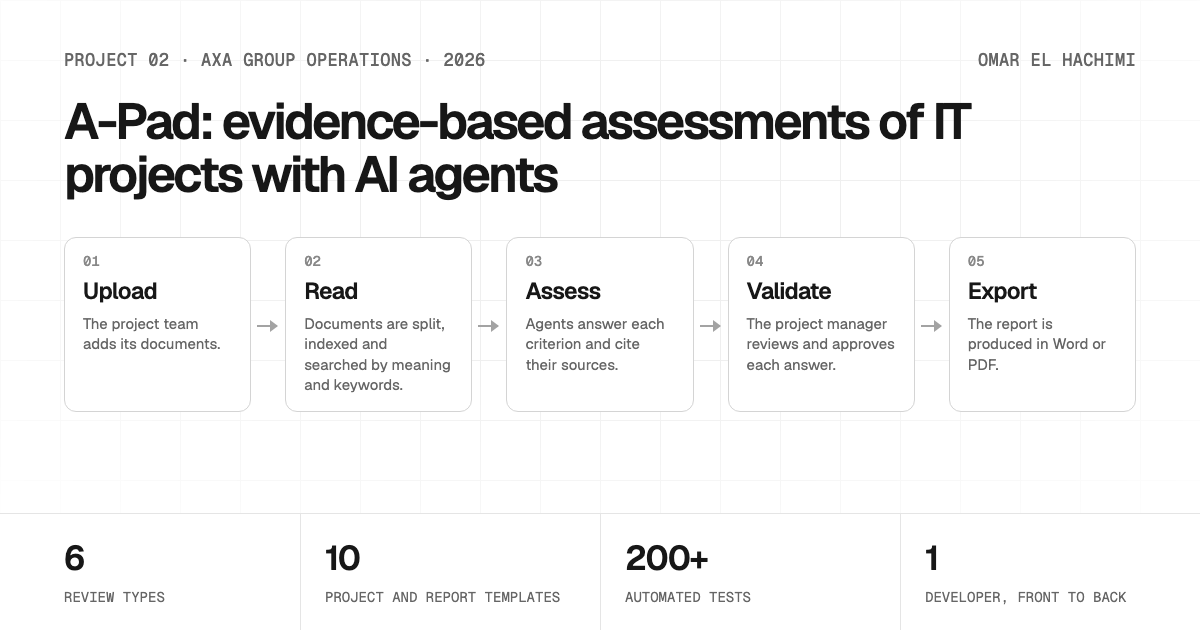
- UploadThe project team adds its documents.
- ReadDocuments are split, indexed and searched by meaning and keywords.
- AssessAgents answer each criterion and cite their sources.
- ValidateThe project manager reviews and approves each answer.
- ExportThe report is produced in Word or PDF.
What I built
- Three reusable engines. Evidence retrieval, agentic evaluation and cited report generation. Each evaluation process or report is a template, so the same engines serve very different reviews.
- An agent loop per criterion. Retrieve, answer, check the answer, retry if needed, up to three attempts. Criteria are ordered by dependency, and independent ones run in parallel.
- Hybrid retrieval. Vector and full-text search merged by reciprocal rank fusion, with an optional re-ranker. Each project has its own vector schema in PostgreSQL.
- An explicit gate rule. A review passes only if every mandatory criterion is met and the weighted score reaches 80%. A project manager can override, and the reason is recorded.
- Built for production. A stateless API, queues and worker pools for ingestion, evaluation and export, processing that resumes after a failure, live progress in the browser, an audit log, LLM cost control, and Word, PDF and JSON export.
Design choices
Evidence over opinion
A verdict is only useful if a person can check it in seconds, so every answer links to the passage it came from. Project managers spend their time validating instead of searching.
Write the rule down
The pass rule is explicit and the same for every project: every mandatory criterion met and a weighted score of at least 80%. A person can still override it, and the reason is kept.
Templates, not one-off tools
Each new kind of review is a template on the same three engines, so a new use case is configuration rather than a new application.
Stack
Python 3.12 · FastAPI · LangGraph · SQLAlchemy 2 · PostgreSQL 16 · pgvector · Redis Streams · MinIO · React 19 · Vite · Tailwind · Docker · Helm · OpenShift · Mistral Document AI (OCR)
Questions
How can AI agents assess an IT project?
Split the review into criteria, let an agent retrieve evidence for each criterion from the project's own documents, answer with citations, check its own answer, and hand every result to a person for validation. A-Pad, built by Omar El Hachimi at AXA, works this way.
How do you make an AI assessment auditable?
Every answer cites the passage it came from, the pass rule is explicit, overrides are recorded with their reason, and every run is logged.